
Wild weather events are becoming more common as our planet heats up and that is only going to increase with frequency over the coming years.
On Tuesday afternoon this week, while I was sitting in an office 17 storeys above the Perth CBD, our home 30km away was getting lashed by a storm.
This was a freak weather event. Our little home weather station recorded the outdoor temperature as 41.3 Celsius at 1pm (the day’s maximum was 42.7 just ten minutes earlier) and rapidly dropped to 21.3C by 1.25pm. This coincided with loud cracks of thunder, winds gusting to around 90km/h and a deluge of rain – 20mm in just half an hour.
My wife sent me this video from home.
I couldn’t believe it. At first, I thought this must have been a video from a few years ago that I couldn’t remember.
Looking out of the north-facing office window all I could see was sunshine. But when I pulled the blinds back from the windows that face eastward all I could see in the distance was thick grey clouds concealing the hills, which are usually clearly visible on a summer’s day.
The power soon went out, not only in our neighbourhood but across a wide stretch of land reaching at least 120km northeast into the wheatbelt.
Western Power estimated that 33,000 homes were without power and the extent of the damage meant they could not provide accurate restoration times for most areas that were impacted.
When I drove home that evening the roads had been washed clean by the downpour but once I was off the highway there were branches and trees down in many places. There were more branches than bare pavement on the side of our road.
Fortunately for us there was no damage to our home but others were much worse off.
And, as dusk fell, the neighbourhood became much darker than usual. No street lights were on and nobody was connected to grid electricity. Our local supermarkets and shops were closed too.
But our lights were on. Thanks to our home battery. We have had electricity throughout a blackout that has lasted for more than 48 hours – the longest I have experienced since we moved to the Perth hills in 2010.
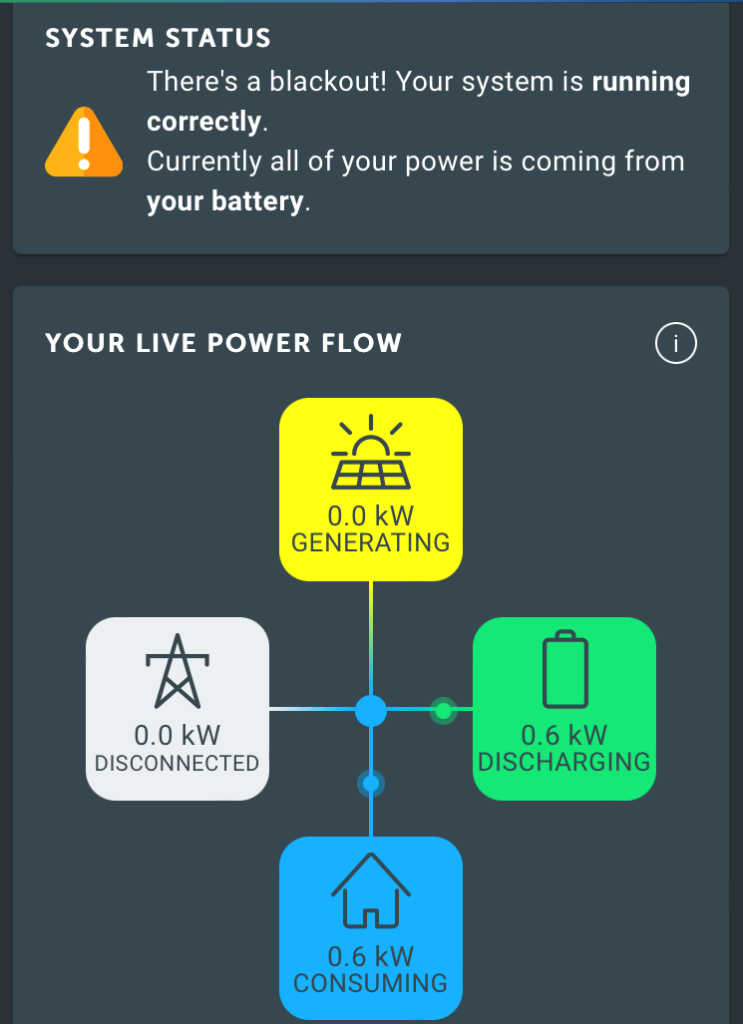
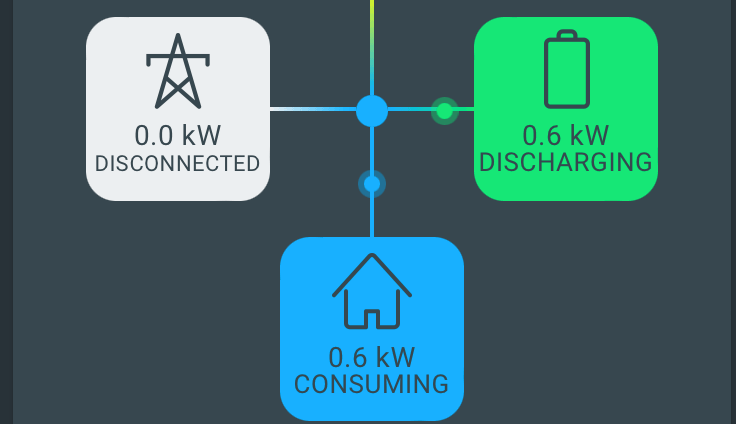
With the storm hitting early in the afternoon, our battery was fully charged and was comfortably discharging back into our home, feeding the two circuits backed up by the battery in a blackout.
Our fridge was still going, our modem was up and running, we had lights and could see what we were doing. Our ceiling fans were still going too so we had a comfortable night’s sleep despite the warm temperatures.
At first, we were cautious and kept our power use to a minimum. But when I checked our battery the next morning, around 7am, it was at 70% charge and was already being charged up again from the early morning sun!
That night my son got an extension lead so he could watch TV using the power point in the kitchen, and the following morning, 42 hours after we lost grid electricity, we decided to switch the pool pump back on – we were still being powered from the rooftop solar PV and generating enough electricity to charge the battery at the same time.
We also managed to keep the meat in our freezer frozen, avoiding much of the cost and wastage many people experienced during this prolonged power outage.
The primary reason we invested in a house battery was to reduce greenhouse gas emissions from our home electricity use, but having backup during a power cut is a major bonus!
This was the fourth or fifth time we have been able to keep the power on during a blackout since our battery was installed in May 2021.
A few years from now I am sure many more people will be using battery technology to get by when the power goes out.
The power eventually came back on around 3.15pm on Friday – four full days after the power had gone out. I have to say it wasn’t all smooth sailing. Only two of the circuits are set-up for backup power in our system so we still couldn’t use our cooker, dishwasher or washing machine and the hot water ran out on the third night – but it definitely would have been worse without the battery.
Have you been able to get by in a blackout with a house battery? Can you plug your EV into the house to keep the power on?
One response to “Keeping the lights on in a blackout”
-

[…] See how we got by in a four-day power cut. […]
LikeLike
 Chasing Zero
Leave a reply to Seven lessons learned from having a house battery – Chasing Zero Cancel reply